
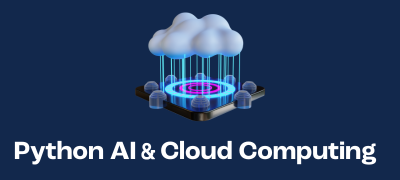
The course focuses on applied AI and cloud-based machine learning, equipping students with hands-on skills in model training, AI agent development, and cloud deployment for careers at the forefront of modern tech.
Build a data pipeline that runs in the cloud and uses both a machine learning model you trained and a large language model (LLM) to add meaning to the data.
What you’ll learn
This is course 3 of 4 in the Data Engineering track: Intro to Programming → Python for Data Analysis → Python for AI & Cloud → Python & Data Practicum.
- Week 1: Production Python. Write code like professional teams: classes, type hints, data validation, automated tests, and packages.
- Weeks 2-4: Machine learning. Train and evaluate regression and classification models, choose which one to use, and package it as a component.
- Weeks 5-7: AI. Learn how LLMs work, write effective prompts, and build RAG systems and AI agents.
- Weeks 8-11: Cloud and pipelines. Learn core cloud concepts, load data into a cloud database, combine models and LLMs in a pipeline, and learn basic AWS.
What you’ll build
A cloud data pipeline that uses machine learning and AI, using daily weather data.
- Train models with scikit-learn to predict the weather and classify days. Turn the best model into a reusable, tested Python component.
- AI tools. Build a chatbot that answers questions using outside documents (retrieval-augmented generation, or RAG) and aI agents that can use tools.
- ETL pipeline. Build an extract-transform-load (ETL) pipeline that pulls a year of weather data from a public API into a Supabase cloud database. It labels each day with your model, then uses an LLM to write a short recommendation for each day.
Tools you’ll use
Python, scikit-learn, Pydantic, pytest, OpenAI API, LlamaIndex, smolagents, Supabase, SQL, Prefect, AWS, git & GitHub.
Prerequisites
You must complete Python for Data Analysis first. You should be comfortable with:
- Loading, cleaning, and analyzing data with Pandas
- Writing SQL queries, including joins and aggregations
- Getting data from APIs
- Git and GitHub, including pull requests
Supplies
- A laptop or desktop computer with at least 100GB of free disk space and 16GB of RAM. Chromebooks and similar devices do not work.
- Mac: macOS Sequoia or later
- Windows: Windows 11 or later
- Linux: a supported version of Ubuntu
- A webcam for live mentor sessions (preferred, not required)
- Reliable internet
- VS Code
- A free GitHub account